Picture this: you’re reviewing a supplier’s Life Cycle Assessment (LCA) report. You spot the impact of electricity and pause. "Wait," you think, "don’t they use 100% renewable energy?"
If you’re used to Greenhouse Gas (GHG) Protocol reporting, seeing a non-zero value for renewables might be jarring. In traditional carbon accounting, we often treat renewable certificates as having 0 kg CO2eq. But in the physical reality, the story is more complex.
Why is the impact 0 in carbon accounting? Conventions
In standard carbon accounting, electricity impacts are often "discarded" if you hold a certificate. This follows the GHG Protocol’s Market-Based reporting convention.
This approach is designed as a financial incentive rather than a real physical measurement. The logic is to encourage corporate investment in green energy, rewarding companies who purchase a contractual instrument – such as a Renewable Energy Certificate (REC) or a Guarantee of Origin (GO).
So is it really burden-free? No, it isn’t
While this works for tracking contractual obligations and carbon offsets, it ignores the embodied emissions. This includes a series of burdens, among others:
- Manufacturing of panels or turbines, including the mining of their raw materials
- Construction of dams, wind farms, or solar farms
- The actual grid, including the mining of their raw materials
- Transportation of equipment
- Maintenance
These are the upstream impacts of "clean" energy. Reporting 0 kg CO2eq only accounts for on-site emissions – and even that is questuionable. It effectively ignores the Scope 3 burdens of the energy provider itself.
What do we do in LCA instead? Describe reality
In LCA we use physical modeling. When we model your footprint, we seek the most specific data possible.
We use physical modeling to find the most specific data possible. We ideally look at the specific electricity mix your provider is purchasing to guarantee your supply. Because not all green energy is equal, the nuance matters.
If they don’t provide a mix, we look for the closest reliable data. Either the average for the provider – not necessarily your contract – or even the regional or national average. We look for reliable descriptions, not just marketing statements (like “green” or “all-renewable”), because unfortunately people mean very different things with those statements. Such a pictures is much more realistic than just ignoring the burdens of electricity.
Wait, if renewables have an impact… are they bad? No, not at all
You’ll notice that most of the impacts mentioned above are infrastructure, or front-loaded impacts. They happen once, and energy is generated over a long period of time. Renewable sources of energy are therefore cleaner than fossil ones.
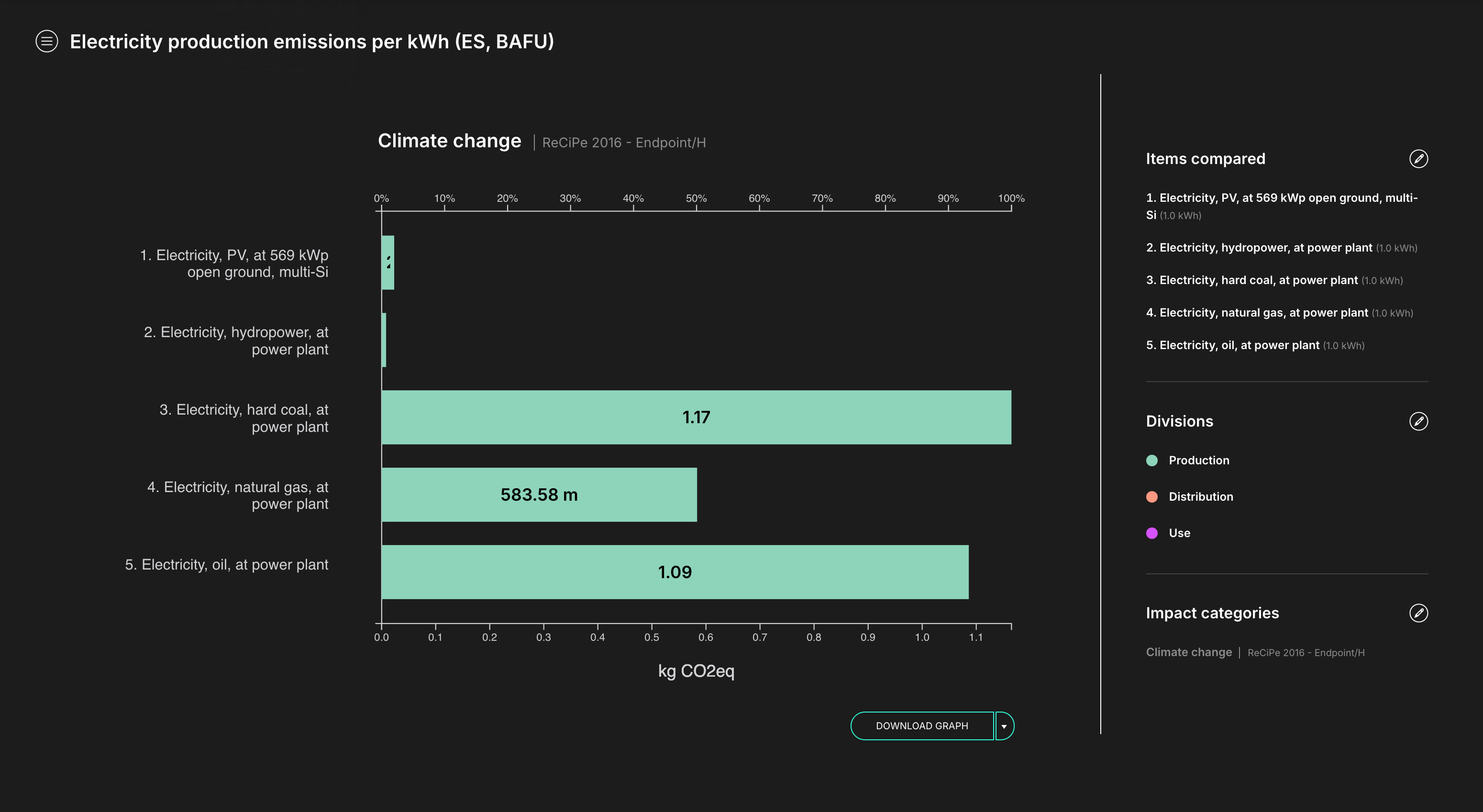
They’re much cleaner, in fact. A quick check for Spain based on BAFU shows them being 25-50 times smaller. Not percent, times. More than an order of magnitude difference. And yet, it is physically impossible for the impact of renewables to be zero.
The purpose is to guide better decisions
This is precisely the reason why we account like this in LCA. Because it allows us to tell appart the good from the bad, but also the best from the good. More efficient electricity generation – among renewables – makes a difference. It reflects reality more precisely, and as such, allows people to make more informed decisions.
The numbers you see in an LCA aren't a penalty; they are an accurate measurement of the resources required to power your world. By reflecting reality precisely, we empower better, more informed decisions for a true energy transition.